The cryptocurrency market continues to evolve at a rapid pace, offering investors unique opportunities for capital growth. However, effective portfolio management requires deep analysis, diversification, and adaptation to market trends.
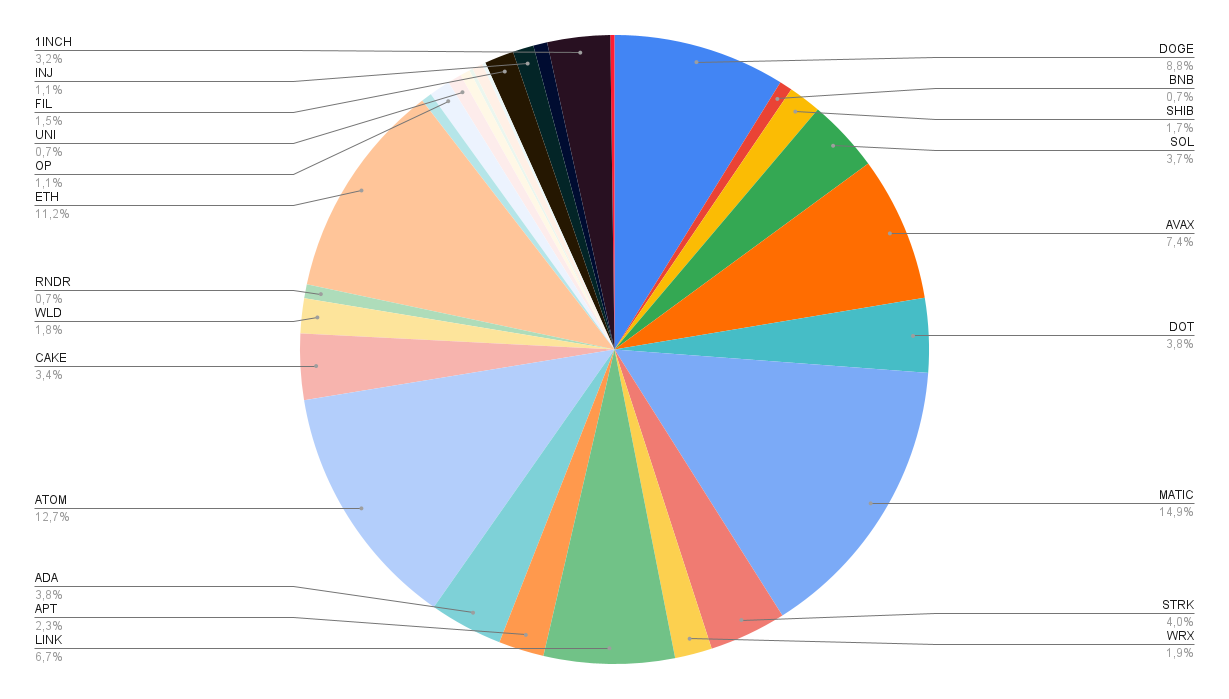
In this case, we’ll review the structure of our portfolio with total assets under management (AUM) of $10 million, as illustrated in the chart below, and discuss the key aspects of managing such investments.
Top 3 Assets and Their Roles
The chart highlights three leading positions:
- MATIC (14.9%) – The token of Polygon, an Ethereum scaling platform. Its high allocation is due to the rising popularity of DeFi and NFT projects, where Polygon offers low transaction fees and high speed.
- ATOM (12.7%) – The cryptocurrency of Cosmos, an ecosystem of interoperable blockchains. The allocation to ATOM reflects a bet on the development of cross-chain solutions and the decentralized internet.
- ETH (11.2%) – Ether, the native currency of Ethereum. Its significant share serves as the portfolio’s anchor, providing liquidity and protection against sharp volatility in other assets.
Together, these assets form the core of the portfolio, making up more than 38% of AUM. The selection is based on fundamentals such as market capitalization, technological prospects, and—most importantly—an optimal entry point.
Balancing Growth and Risk
The next group of assets each holds between 6% and 8% of the portfolio:
- DOGE (8.8%) – A meme cryptocurrency with high volatility. Its presence may be part of a speculative strategy for short-term plays.
- AVAX (7.4%) – The token of Avalanche, an Ethereum competitor. Investment in AVAX reflects interest in high-performance, low-fee blockchains.
- LINK (6.7%) – Chainlink, a decentralized oracle network. LINK’s role is to ensure reliable data for smart contracts, making it a key part of DeFi infrastructure.
These assets combine growth potential with relatively controlled risk, supported by steady demand from both developers and users.
Diversification and Experimentation
The remaining assets (BNB, SOL, DOT, and others) each make up less than 5% of the portfolio but play an important role in reducing risk concentration:
- BNB (3.8%) and SOL (3.7%) – Tokens of Binance Smart Chain and Solana. Their presence allows participation in ecosystems with fast transactions.
- DOT (3.8%) – Polkadot, a project enabling blockchain interoperability. The investment in DOT signals a long-term bet on cross-chain technologies.
- SHIB (1.7%) and CAKE (3.4%) – Meme coins and PancakeSwap’s token. Small allocations to these assets can serve as hedges or exposure to short-term trends.
Smaller positions provide portfolio flexibility, allowing quick responses to market changes and experimentation with new ideas without taking on significant risk.
It’s important to note that, despite the fundamental strengths and prospects of each individual asset, the most critical factor in investment decisions is the optimal entry price. Experience shows that timing your entry often has a greater impact on returns than the intrinsic qualities of the asset itself.
Conclusion
A portfolio with $10 million AUM demonstrates a balance between aggressive growth and capital protection. Top positions in MATIC, ATOM, and ETH provide a strong foundation, while mid-sized and smaller allocations open access to promising niches. Successful management of such a portfolio requires:
- Constant analysis of market signals
- Flexibility in asset reallocation
- Strict risk control
All data is current as of the time of writing.